An RFI—Request for Information—is supposed to be the cleanest part of procurement.
No negotiation. No pricing pressure. No commitment.
Just a structured way to understand:
• who’s out there
• what they can do
• whether they’re worth engaging further
In theory, it’s simple.
In practice, most RFIs either get ignored, misunderstood, or produce pages of information that don’t actually help you decide anything.
That gap—between asking and learning—is where RFIs often fail.
The real purpose of an RFI (beyond the definition)
Formally, an RFI is used early in the sourcing process to gather information about suppliers, capabilities, and approaches.
But the real purpose is more precise:
To reduce uncertainty before you invest time in evaluation or negotiation.
A good RFI should help you answer questions like:
• Is this a solved problem, or will vendors interpret it differently?
• Are there established players, or is the market fragmented?
• Do suppliers align with how we want to operate?
• What are we not thinking about yet?
If your RFI doesn’t sharpen your understanding, it’s just paperwork.
Why most RFIs fall flat
There are a few patterns that show up repeatedly.
They ask for everything—and learn nothing
Long questionnaires. Dozens of sections. Generic capability checklists.
Suppliers respond with equally generic answers:
• “Yes, supported”
• “Customizable”
• “Best-in-class”
You end up with volume, not insight.
They are written without a clear intent
Many RFIs are created before the internal team aligns on what actually matters.
So the document becomes a collection of:
• stakeholder inputs
• copied templates
• “just in case” questions
Without a clear objective, the responses can’t be meaningfully compared.
They ignore how suppliers actually respond
Suppliers don’t approach RFIs neutrally.
They:
• interpret vague questions differently
• emphasize strengths
• avoid committing where things are unclear
If your questions leave room for interpretation, your answers will be inconsistent.
What a good RFI actually does
A well-written RFI is not comprehensive. It is intentional.
It should:
• guide suppliers toward relevant, comparable responses
• surface meaningful differences between vendors
• reduce follow-up questions later
• make the next step (RFP, demo, shortlist) obvious
Think of it less as a document—and more as a filter.
A practical RFI structure (that actually works)
You don’t need a 20-page document. You need a clear structure with purpose.
Context (don’t skip this)
Most RFIs jump straight into questions.
That’s a mistake.
Start by clearly explaining:
• your organization (briefly)
• the problem you’re trying to solve
• what success looks like
• how this RFI will be used
This does two things:
• suppliers tailor their responses
• you get more relevant, thoughtful answers
Scope definition
Be explicit about what you are—and are not—looking for.
For example:
• in scope: procurement workflow automation
• out of scope: full ERP replacement
Without this, suppliers will expand the problem in their favor.
Targeted capability questions
This is where most RFIs go wrong.
Instead of asking:
• “Do you support X?”
Ask:
• “How is X handled in your system today?”
• “What are the limitations or dependencies?”
• “Where have you seen this fail in real scenarios?”
You’re not looking for confirmation.
You’re looking for how things actually work.
Scenario-based questions
This is one of the most underused techniques.
Give a realistic situation and ask how they would handle it.
Example:
“A requisition is raised with incomplete supplier information and needs urgent approval. How would your system handle this?”
Now you’re testing:
• workflow flexibility
• edge-case handling
• real-world usability
This reveals far more than feature lists.
Integration and operational fit
Instead of generic questions like:
• “Do you integrate with ERP systems?”
Ask:
• “What integrations are standard vs custom?”
• “What is required from our side to implement?”
• “Where do integrations typically fail or slow down?”
You’re assessing implementation reality, not capability claims.
Commercial and engagement basics (keep it light)
At RFI stage, avoid deep pricing breakdowns.
Instead, ask:
• typical pricing model (subscription, usage, etc.)
• implementation timelines (ranges, not commitments)
• typical customer profile
You’re trying to understand fit—not negotiate.
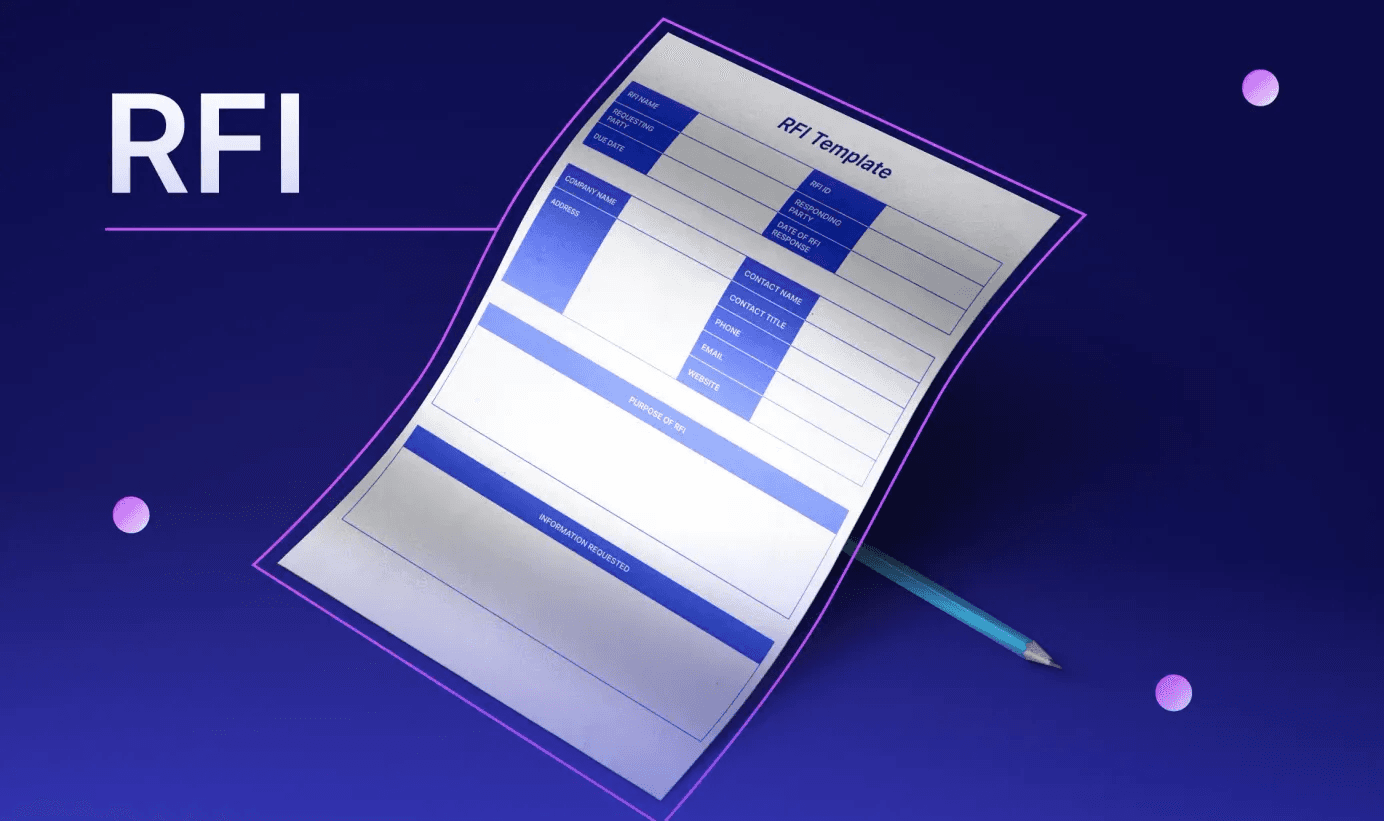
A simple RFI template (usable, not bloated)
Here’s a clean structure you can actually use:
Introduction
• Company overview
• Purpose of RFI
• Expected outcomeProblem Statement
• What you’re trying to solve
• Key challenges todayScope
• In-scope areas
• Out-of-scope areasCapability Questions
• Core workflows
• Key functionalities
• LimitationsScenario-Based Questions
• 2–4 real operational scenariosIntegration & Implementation
• Existing systems
• Expectations
• ConstraintsCommercial Overview
• Pricing approach
• Typical timelinesSubmission Guidelines
• Format
• Deadline
• Contact point
Writing tips that actually improve responses
Be precise, not exhaustive
More questions don’t mean better insight.
Better questions do.
Ask for explanation, not confirmation
“Yes/No” answers are rarely useful.
“How” and “when” are far more revealing.
Remove ambiguity wherever possible
If a question can be interpreted in two ways, it will be.
Keep suppliers in mind
A well-structured RFI makes it easier for them to respond clearly.
That directly improves your output.
Design for comparison
If responses can’t be compared easily, the RFI has failed.
Where RFI fits in a modern procurement flow
Traditionally:
RFI → RFP → RFQ → Selection
But in practice, this is becoming more fluid.
Some teams:
• skip RFIs entirely (risky)
• or overuse them (slows things down)
The right use of an RFI is when:
• the problem is not fully defined
• the market is unclear
• internal alignment is still forming
In those cases, a good RFI can save significant time later.
A final thought
An RFI is often seen as a preliminary step.
But it quietly shapes everything that follows.
If it’s vague, the process stays vague.
If it’s clear, decisions come faster.